
Custom Longboards: Deck Shapes, Lengths and Who They Suit
A custom longboard skateboard is a personalised board built around your riding style, preferred deck shape, length, wheelbase and components. The right combination improves stability, turning control, comfort and overall riding performance.
Whether you enjoy relaxed cruising, sharp carving, downhill riding or freestyle movement, choosing the correct longboard design makes a practical difference. This guide explains longboard deck shapes, standard lengths, materials and essential components to help beginners and experienced riders build a suitable setup.
What Is a Custom Longboard Skateboard?
A custom longboard skateboard is a longboard configured with selected deck dimensions, construction materials, trucks, wheels, bearings and graphics to match a rider’s requirements.
Unlike a standard ready-made board, a custom setup gives you control over important specifications. You can select a compact cruiser for daily travel, a flexible deck for carving or a longer symmetrical design for dancing and freestyle riding.
A custom longboard skateboard generally includes these components:
- Deck: The main wooden or composite platform that supports your feet.
- Trucks: Metal steering components connecting the wheels to the deck.
- Wheels: Urethane components that determine grip, rolling comfort and slide behaviour.
- Bearings: Small components fitted inside the wheels to support rotation.
- Grip tape: An abrasive surface that improves shoe traction.
- Hardware: Bolts, nuts and mounting accessories that secure the complete setup.
- Custom graphic: Personal artwork, colours or printed designs that give the deck an individual appearance.
Every component contributes to the riding experience. Selecting them according to your intended use creates a more practical longboard than choosing parts based only on appearance.
Why Does a Custom Longboard Skateboard Matter?
A custom longboard skateboard matters because different riding styles require different combinations of stability, flexibility, turning response and deck dimensions.
A commuter travelling across smooth city roads needs a different setup from someone practising downhill slides or longboard dancing. A single standard configuration cannot provide the same performance for every activity.
Customisation provides five important benefits:
- Better riding comfort: Suitable deck dimensions and flex support a comfortable standing position.
- Improved stability: An appropriate wheelbase and mounting style create predictable handling.
- Controlled turning: Truck selection and deck geometry influence steering response.
- Personal appearance: Custom graphics and colours create a distinctive board.
- Purpose-based construction: Components can be selected for cruising, carving, freestyle or downhill riding.
For example, a beginner who travels regularly across uneven roads benefits from a stable deck, soft wheels and comfortable foot positioning. An experienced freeride rider needs a different combination of deck stiffness, concave and wheel characteristics.
Custom Longboard Skateboard vs Standard Skateboard
A longboard provides a longer riding platform and generally focuses on cruising, carving, commuting and specialised longboard disciplines. A standard skateboard focuses more on street tricks, skatepark movements and technical manoeuvres.
Understanding the longboard vs skateboard difference helps you select the right platform before purchasing individual components.
| Feature | Longboard | Standard Skateboard |
|---|---|---|
| Deck length | Generally 28–46+ inches | Generally 28–33 inches |
| Deck width | Often 8.5–10 inches or wider | Often 7.5–8.5 inches |
| Main purpose | Cruising, carving and dancing | Street and park skating |
| Wheels | Usually larger and softer | Often smaller and harder |
| Stability | Designed for comfortable rolling | Designed for responsive tricks |
| Turning | Depends on wheelbase and truck setup | Usually quick and responsive |
| Riding surface | Suitable for different road conditions | Best suited to smoother skating surfaces |
These dimensions represent common categories rather than fixed manufacturing standards.
A longboard suits riders who prioritise distance, smooth movement and flowing turns. A standard skateboard suits riders who want to practise ollies, kickflips, grinds and other technical tricks.
Which Longboard Deck Shapes Are Available?
Longboard deck shapes determine foot positioning, turning behaviour, stability and the type of riding a board supports.
Understanding the major longboard deck shapes makes it easier to select a design that matches your experience and riding goals.
Pintail Longboard Shape
A pintail longboard features a pointed front and rear section with a wider standing platform in the middle.
This traditional design is popular for relaxed cruising because its directional shape supports smooth movement and comfortable foot placement.
Who it suits:
- Beginners learning basic longboard balance.
- Commuters travelling across smooth roads.
- Riders enjoying relaxed coastal or park cruising.
- People who prefer traditional surf-inspired designs.
Pintail decks generally work well with soft wheels that absorb small road vibrations. However, check wheel clearance and truck positioning before selecting larger wheels.
Drop-Through Longboard Shape
A drop-through longboard features mounting holes that allow the truck baseplates to sit through the deck.
This mounting arrangement lowers the standing platform, making pushing and foot braking more comfortable during longer rides.
Who it suits:
- Daily commuters.
- Beginners who prefer a lower riding position.
- Long-distance cruising riders.
- Freeride riders who want a lower platform.
The lower centre of gravity provides a more planted feeling, although turning response depends on truck geometry, wheelbase and deck design.
Drop-Deck Longboard Shape
A drop-deck longboard has a lowered standing platform between raised truck mounting areas.
The lowered foot platform improves stability and reduces the distance your pushing foot travels towards the ground.
Who it suits:
- Long-distance commuters.
- Riders who prioritise a low standing position.
- Experienced riders practising controlled downhill activities.
- People who prefer additional stability during longer sessions.
Drop-deck designs are useful when comfortable foot positioning and predictable handling are important.
Symmetrical Longboard Shape
A symmetrical longboard has a similar nose and tail design, allowing riders to travel in either direction without changing the board’s overall feel significantly.
This shape is particularly useful for freestyle and freeride activities where switch riding and slides are common.
Who it suits:
- Freestyle longboard riders.
- Freeride enthusiasts.
- Riders practising 180-degree slides.
- Experienced skaters who enjoy directional flexibility.
Symmetrical decks often feature wheel cut-outs and deeper concave to support foot control during demanding movements.
Kicktail Longboard Shape
A kicktail longboard includes one or two raised ends that help riders lift the board, perform small tricks and navigate obstacles.
A single kicktail supports directional cruising, while a double-kicktail design offers additional flexibility for freestyle movements.
Who it suits:
- Urban commuters navigating pavements.
- Riders who regularly encounter small curbs.
- Beginners learning basic board manoeuvres.
- Freestyle riders practising manuals and small tricks.
A kicktail makes a longboard more versatile, especially when riding through areas with frequent obstacles.
How Long Should a Custom Longboard Skateboard Be?
A custom longboard skateboard generally measures between 28 and 46 inches or more, depending on its intended riding discipline.
Deck length affects portability, standing space and overall handling. However, wheelbase is equally important because it determines the distance between the front and rear truck mounting positions.
| Riding Style | Typical Deck Length | Main Advantage |
|---|---|---|
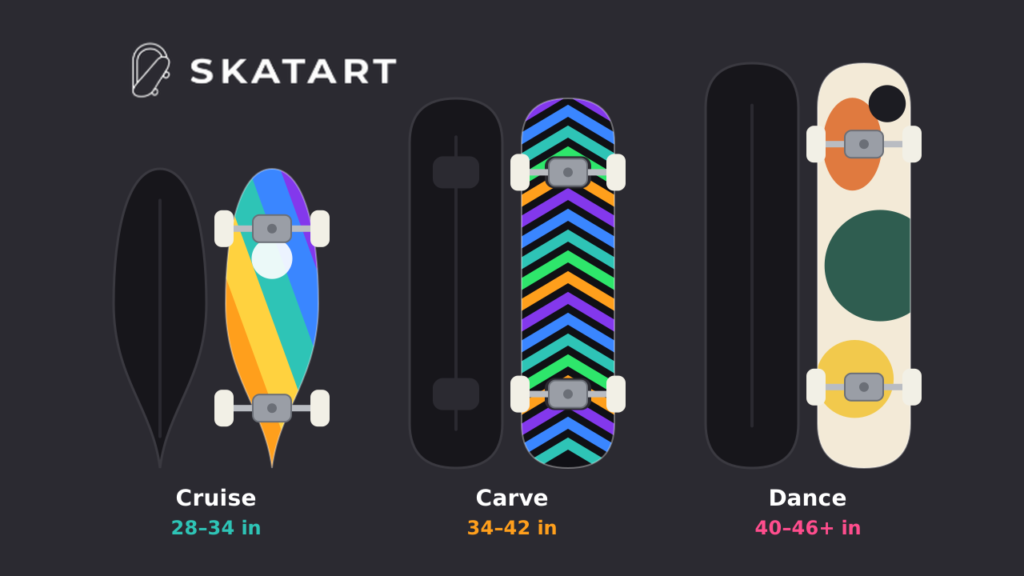
| Compact cruising | 28–34 inches | Easy carrying and turning |
| General cruising | 32–40 inches | Comfortable everyday riding |
| Carving | 34–42 inches | Smooth directional turns |
| Freestyle | 35–40 inches | Better movement and manoeuvrability |
| Freeride | 36–42 inches | Foot control and stability |
| Dancing | 40–46+ inches | Larger standing platform |
| Downhill | 35–42 inches | Stable riding geometry |
These measurements are starting points, not compulsory size requirements.
How to Choose Longboard Length by Rider Height
Rider height provides a useful starting reference, but riding style, stance width, wheelbase and personal comfort determine the final choice.
Consider these practical guidelines:
- Below 5 feet 4 inches: Explore compact and medium decks around 28–36 inches.
- Between 5 feet 4 inches and 5 feet 10 inches: Compare decks around 32–40 inches.
- Above 5 feet 10 inches: Explore medium and longer decks around 36–46 inches.
A taller rider does not automatically require the longest available deck. The standing platform must accommodate a comfortable stance without making the board difficult to control.
Read the Skateboard Deck Size Guide to understand how deck measurements influence skateboard selection.
What Is the Difference Between Wheelbase and Deck Length?
Deck length measures the complete distance from the nose to the tail, whereas wheelbase measures the distance between the inner truck mounting positions.
A longer wheelbase generally creates more predictable stability and wider turning arcs. A shorter wheelbase produces quicker turning and a more responsive feel.
For example, two 40-inch longboards can handle differently because their truck mounting positions, deck shapes and wheelbase measurements are not identical.
Choose wheelbase according to your preferred riding experience rather than relying only on the total deck length.
Which Longboard Construction Material Should You Choose?
Longboard construction materials influence deck weight, stiffness, flexibility and durability.
The three common construction options include maple, bamboo and composite materials.
Canadian Maple Construction
Canadian maple is widely used in skateboard manufacturing because its laminated wooden veneers create a strong and supportive deck.
Multiple veneer layers are bonded under pressure to produce a shaped platform with controlled stiffness.
Choose maple when you want:
- A firm and supportive riding platform.
- Consistent deck construction.
- Traditional skateboard-style performance.
- A durable foundation for custom graphics.
Explore Seven Ply Canadian Maple Skateboard to understand how laminated maple construction supports skateboard deck strength.
Bamboo Construction
Bamboo longboards generally offer a lighter and more flexible riding experience, depending on the number of layers and construction method.
Manufacturers frequently combine bamboo with fibreglass or other reinforcement materials to control flex and improve structural performance.
Bamboo suits riders who enjoy carving and a responsive deck feel.
Composite Construction
Composite longboards combine materials such as fibreglass, carbon fibre, wood and foam cores.
These constructions allow manufacturers to control stiffness, weight and flex for specific riding applications.
They are particularly useful for specialised performance designs where precise deck characteristics matter.
How to Select Wheels for a Custom Longboard Skateboard
Longboard wheels influence grip, rolling comfort, acceleration and sliding behaviour. Wheel diameter, width, lip profile and wheel durometer all contribute to performance.
Understand Wheel Durometer
Wheel durometer measures the hardness of the urethane wheel using a recognised hardness scale.
A lower durometer number indicates softer wheels, while a higher number indicates harder wheels.
| Wheel Durometer | Characteristics | Suitable Riding |
|---|---|---|
| 75A–78A | Very soft, high grip | Rough-road cruising |
| 78A–80A | Soft and comfortable | General cruising |
| 80A–83A | Medium hardness | Carving and versatile riding |
| 84A–86A | Harder and easier to slide | Freeride and specialised setups |
These are approximate selection ranges, not universal performance standards.
For beginners, softer wheels around 78A–80A provide comfortable rolling across ordinary road imperfections.
Larger wheels also roll over small cracks more easily, but their size requires sufficient deck clearance to prevent wheel bite.
How to Choose Trucks and Bearings
Trucks and bearings complete the mechanical setup of a custom longboard skateboard.
Selecting Longboard Trucks
Reverse kingpin trucks are commonly used on longboards because their geometry supports responsive turning and carving.
Truck width must match the deck dimensions and intended wheel placement. Incorrect sizing affects handling and wheel clearance.
Consider these factors:
- Truck width: Match the axle width to the deck and wheel setup.
- Baseplate angle: Influences how the truck responds when leaning.
- Bushing hardness: Changes turning resistance and rebound.
- Mounting style: Top-mount and drop-through designs provide different riding positions.
Beginners benefit from a balanced truck setup that offers predictable turning without excessive looseness.
Selecting Longboard Bearings
Bearings support wheel rotation and influence rolling efficiency.
ABEC ratings are commonly used to classify manufacturing tolerances, but a higher ABEC number does not automatically guarantee a faster or better longboard bearing.
Material quality, lubrication, maintenance and riding conditions also influence performance.
Choose reliable bearings, keep them clean and dry, and inspect them regularly for dirt, corrosion and unusual noise.
How to Build a Custom Longboard Skateboard
Building a custom longboard skateboard requires compatible components, accurate measurements and suitable assembly tools.
Follow these six steps to create a practical setup.
Step 1: Select the riding style
Decide whether the board is intended for cruising, carving, commuting, freestyle, dancing or downhill riding.
This decision determines the deck shape, dimensions and component requirements.
Step 2: Choose the deck dimensions
Select the deck length, width and wheelbase according to your riding style and comfortable stance.
Check the mounting pattern before purchasing trucks.
Step 3: Select the construction material
Compare maple, bamboo and composite decks according to stiffness, weight and flexibility.
Choose a construction that supports your intended riding conditions.
Step 4: Match the trucks and wheels
Select compatible trucks and wheels, checking axle width, wheel diameter and clearance.
Install suitable risers when required to reduce wheel-bite risk.
Step 5: Install bearings and grip tape
Apply grip tape evenly across the deck and install bearings carefully into the wheels.
Avoid damaging bearing shields or forcing components into incorrect positions.
Step 6: Complete the assembly and inspection
Use appropriate assembly tools, including a skate tool, screwdriver and socket wrench.
Tighten mounting hardware securely, check wheel rotation and inspect truck movement before the first ride.
Start with a slow test on flat ground and verify that the wheels do not contact the deck during turns.
Common Mistakes When Choosing a Custom Longboard
Selecting a longboard without understanding its intended use creates unnecessary spending and handling problems.
Avoid these five common mistakes:
- Choosing length by appearance: A longer deck does not automatically provide the best riding experience.
- Ignoring wheel clearance: Oversized wheels and unsuitable truck positioning increase wheel-bite risk.
- Selecting unsuitable flex: Excessive flexibility reduces stability during faster riding.
- Ignoring component compatibility: Incorrect truck widths and mounting patterns create assembly problems.
- Prioritising graphics over construction: Attractive artwork cannot replace suitable materials and reliable components.
A balanced custom setup starts with riding requirements and ends with compatible components.
Who Should Buy a Custom Longboard Skateboard?
A custom longboard skateboard suits beginners, daily commuters, creative riders and experienced skaters who want a setup matched to their individual requirements.
Here is a simple selection guide:
- Beginners: Choose a stable cruising deck with comfortable dimensions and soft wheels.
- Daily commuters: Select a lower platform with suitable wheel diameter and reliable bearings.
- Carving enthusiasts: Explore responsive trucks and decks with appropriate flex.
- Freestyle riders: Choose symmetrical decks with kicktails and sufficient standing space.
- Longboard dancers: Select longer and wider decks that provide room for footwork.
- Downhill riders: Prioritise stiff construction, controlled wheelbase geometry and appropriate foot support.
Riders should also consider their experience level and local road conditions before purchasing specialised equipment.
Final Word
The best custom longboard skateboard combines the right deck shape, length, wheelbase, construction material and components for your intended riding style. Pintails support relaxed cruising, drop-through designs offer a lower standing position, symmetrical decks suit freestyle activities, and longer dancing boards provide additional foot space.
Start by identifying how you plan to ride, then select compatible components that support comfort, stability and control. A well-planned setup provides a more enjoyable riding experience and gives you greater control over your board’s appearance and performance.
Looking for creative skateboard designs beyond riding equipment? Explore SKATART and shop this month’s Skateboard Wall Art Drop to discover distinctive skateboard-inspired artwork for your space.
