
How to Choose a Skateboard Deck Size for Your Height and Style
Choosing the right skateboard deck size depends on your shoe size, height, riding style, and comfort on the board. Most adult skateboarders start with a deck width between 7.75 and 8.5 inches, while younger riders often prefer narrower decks.
This skateboard deck size guide explains deck width, length, concave, seven-ply maple construction, and compatibility with trucks and wheels.
In this guide, learn how to choose a skateboard for beginners, avoid common sizing mistakes, and find a deck that suits your riding goals.
Skateboard Deck Size Guide: Start With the Right Measurements
The best skateboard deck size depends on shoe size, riding style, and personal comfort, with height serving as a useful secondary guide.
Most adult beginners find an 8.0 to 8.25 inch deck a practical starting point, while smaller riders often prefer narrower boards, and transition skaters favour wider decks.
This skateboard deck size guide explains how to measure a deck, compare widths, choose concave, match trucks and wheels, and avoid common buying mistakes before selecting your first skateboard.
1. Understand Skateboard Deck Measurements
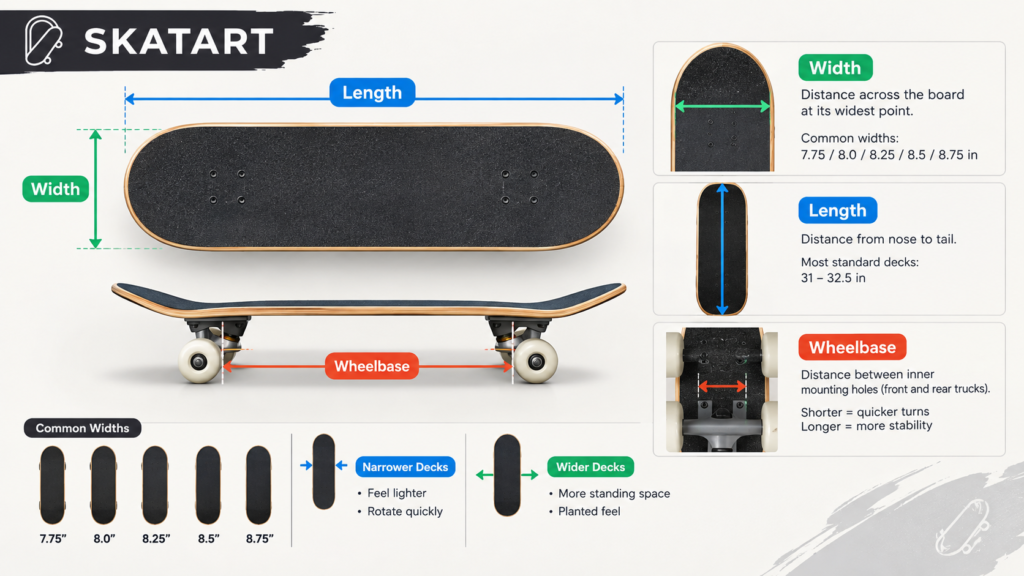
Skateboard deck measurements describe the board’s width, length, and wheelbase, which influence foot placement, turning response, and stability.
Deck width
Deck width is the distance across the board at its widest point, measured in inches.
It is the first measurement to consider because it affects how much room your feet have and how the board responds during tricks.
Common widths include 7.75, 8.0, 8.25, 8.5, and 8.75 inches. Narrower decks feel lighter and rotate quickly, while wider decks provide more standing space and a planted feel.
Deck length
Deck length measures the distance from the nose to the tail. Most standard street skateboard decks measure approximately 31 to 32.5 inches long, although shapes and manufacturers vary.
Length matters, but width usually provides a more useful starting point when choosing a standard skateboard.
Wheelbase
The wheelbase is the distance between the inner mounting holes for the front and rear trucks.
A shorter wheelbase generally creates a quicker turning response, while a longer wheelbase feels more stable during faster riding.
2. Choose Deck Width According to Shoe Size
Shoe size provides a useful starting point because your feet need enough space to control the deck comfortably. Use the following chart as a general guide rather than a fixed rule.
| Shoe size (UK/India) | Suggested deck width |
| UK 2–5 | 7.25–7.75 inches |
| UK 4–7 | 7.75–8.0 inches |
| UK 6–8 | 8.0–8.125 inches |
| UK 7–9 | 8.0–8.25 inches |
| UK 8–10 | 8.25–8.375 inches |
| UK 9–11 | 8.375–8.5 inches |
| UK 10 and above | 8.5 inches or wider |
These ranges overlap because shoe size alone does not determine the best fit. Brands also use different sizing recommendations.
Check your foot placement
Stand on a stationary skateboard with your feet positioned over the truck bolts. Your feet should feel supported without making the board difficult to control.
A small amount of toe or heel overhang is normal. Choose a slightly wider deck if your feet feel cramped, or try a narrower option if the board feels bulky during turns and tricks.
3. Use Height as a Secondary Guide
Height helps narrow your options, particularly for children and younger riders, but it does not determine deck size by itself.
| Rider height | Starting deck width |
| Below 4 feet 5 inches | 6.5–7.25 inches |
| 4 feet 5 inches–5 feet 2 inches | 7.0–7.75 inches |
| 5 feet 3 inches–5 feet 8 inches | 7.75–8.125 inches |
| 5 feet 8 inches–6 feet | 8.0–8.375 inches |
| Above 6 feet | 8.25 inches or wider |
Treat this chart as a broad starting point, not a universal standard. Shoe size, board shape, and riding style can change the preferred width.
4. Match Deck Size to Your Riding Style
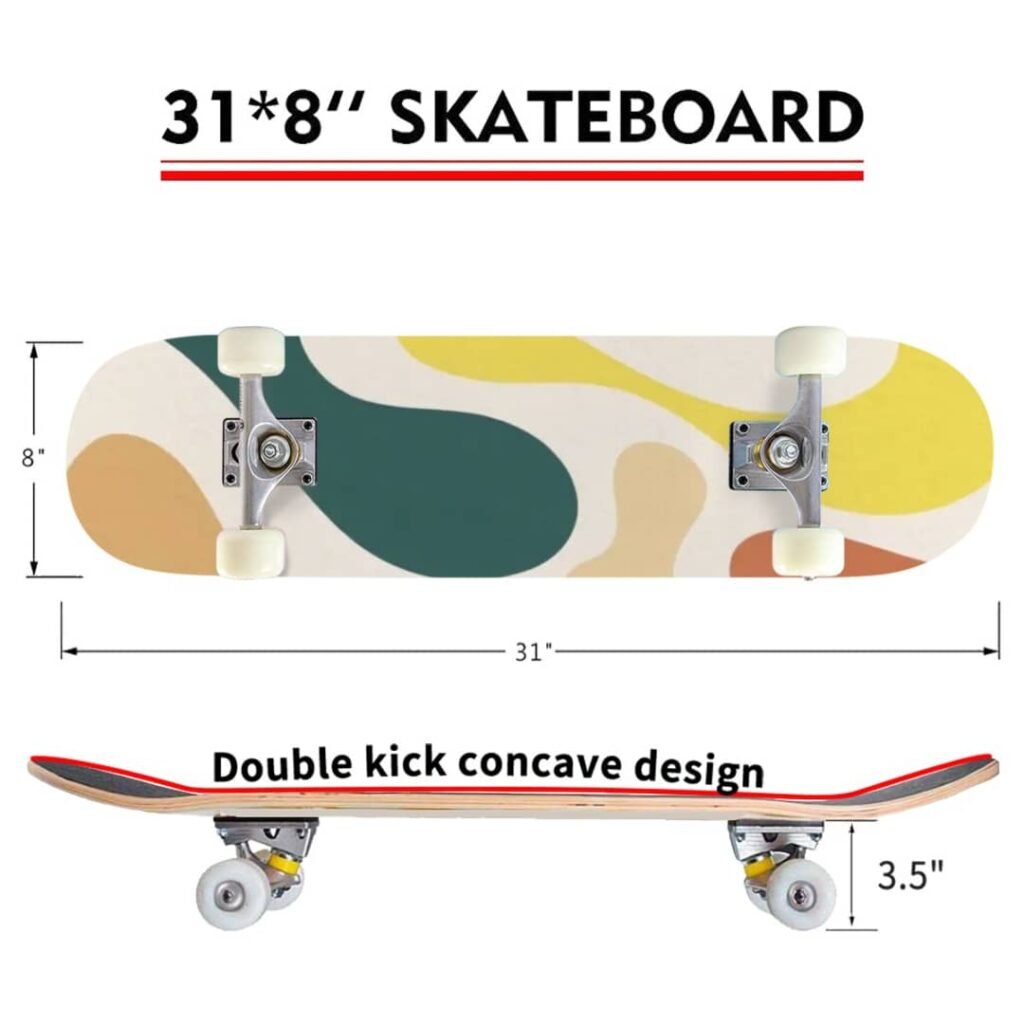
The best deck width depends on the type of skating you plan to do. Street skating rewards quick movement, while bowls and ramps often benefit from a wider platform.
Street skating and technical tricks
Street skaters commonly choose decks between 7.75 and 8.25 inches wide. These boards suit flip tricks, ledges, rails, and other technical movements.
A narrower deck generally rotates with less effort. However, choose a width that still gives your feet enough room for comfortable landings.
Skatepark riding
An 8.0 to 8.5 inch deck suits many skatepark activities, including ramps, banks, and flat-ground tricks. This range offers a practical balance between maneuverability and stability.
Bowls, ramps, and transition skating
Transition skaters often prefer decks measuring 8.5 inches or wider. The extra width provides more standing space and can feel more secure during fast turns and landings.
Cruising around town
Cruising decks vary considerably because some resemble standard skateboards while others use wider, shaped platforms.
Choose according to comfort, turning needs, wheel clearance, and the surfaces you ride.
5. Select the Right Concave
“Concave” describes the inward curve across the deck’s width, which helps position your feet and control the board during turns and tricks.
Low concave
Low concave has a flatter profile and feels comfortable for relaxed riding. It provides a less pronounced edge beneath the feet.
Medium concave
Medium concave balances foot control and comfort. It suits beginners and riders who use one skateboard for street skating and skatepark sessions.
Steep concave
Steep concave creates more pronounced curves along the deck’s sides. Some technical skaters prefer this shape because it provides a stronger sense of foot positioning during tricks.
Concave preference varies between brands. Test different shapes when possible rather than assuming a particular profile is best for every rider.
6. Check the Deck Material and Construction
Seven ply maple is a common skateboard deck construction that uses seven thin layers of wood pressed together with adhesive.
The layered structure provides strength and flexibility for regular skateboarding.
Before buying, inspect these details:
- Wood construction: Check the number of layers and the manufacturer’s material specifications.
- Deck shape: Confirm that the nose, tail, and mounting holes suit your intended setup.
- Finish quality: Look for clean edges, even surfaces, and no visible damage.
- Grip tape: Choose a suitable grip surface that helps your shoes maintain contact with the deck.
- Product condition: Inspect used decks for cracks, water damage, and excessive wear.
A strong deck still wears out through repeated impacts. Replace damaged equipment rather than continuing to ride an unsafe board.
7. Match Trucks and Wheels to the Deck
Trucks and wheels must suit the deck’s width and intended use. A correctly matched setup improves control and reduces problems caused by poorly fitted components.
Choose compatible trucks
The truck axle width should sit close to the deck’s width, although exact measurements and size labels vary by manufacturer. Check the manufacturer’s compatibility chart before purchasing.
For example, an 8.25-inch deck needs trucks designed for a similar width. Trucks that are much narrower or wider can change the board’s balance and wheel position.
Select suitable wheels
Wheel diameter affects clearance, acceleration, and how easily the board rolls over rough surfaces. Many street setups use wheels around 52–55 millimeters, while cruising setups often use larger wheels.
Wheel hardness also matters. Hard wheels suit smooth skatepark surfaces, while softer wheels generally provide a more comfortable ride on rough roads.
Check wheel clearance and consider riser pads when the setup requires additional space between the wheels and deck.
8. Follow This Step-by-Step Buying Process
A simple buying process helps you choose a skateboard that fits your body, skill level, and budget.
- Measure your shoe size: Use your regular skate shoes to identify a starting deck width.
- Consider your height: Use height as a secondary reference, especially for younger riders.
- Choose your riding style: Decide whether you prefer street tricks, skateparks, bowls, or cruising.
- Compare two widths: Test adjacent sizes, such as 8.0 and 8.25 inches, when possible.
- Check the construction: Review the deck material, concave, shape, and finish.
- Match the components: Confirm that the trucks, wheels, and mounting hardware fit the selected deck.
- Test your comfort: Stand on the board and check your balance before riding.
- Inspect the complete setup: Tighten the hardware and check the wheels and trucks before your first session.
9. Five Skateboard Sizing Mistakes to Avoid
Avoiding common sizing mistakes helps you choose a board that feels comfortable and performs as intended.
- Choosing by height alone: Include shoe size, riding style, and personal preference.
- Buying the widest deck available: Extra width does not automatically improve control for every skater.
- Ignoring truck compatibility: Check axle width before assembling the skateboard.
- Overlooking wheel clearance: Confirm that the wheels do not contact the deck during turns.
- Copying another skater’s setup: Their preferred width may not suit your feet or riding goals.
10. Find Your First Skateboard
A skateboard for beginners works best when its dimensions match the rider’s feet, preferred activities, and comfort level.
Most adult beginners can start by comparing 8.0 and 8.25-inch decks, while smaller riders can explore narrower options.
Choose a complete skateboard if you want a ready-to-ride setup with compatible components. An individual deck suits riders who already understand truck sizing and want to build a customized board.
Explore the Skateboard collection, compare available widths, and check each product’s specifications before buying. Use the Shop now option when you are ready to select a deck that matches your measurements and riding style.
Frequently Asked Questions
What size skateboard should I get as a beginner?
An 8.0 to 8.25 inch deck is a practical starting point for many adult beginners. Smaller feet and technical street skating can favour narrower boards, while larger feet and transition skating can favour wider options.
Does skateboard deck width affect tricks?
Yes. Narrower decks generally flip with less effort, while wider decks provide more foot space for catching and landing tricks.
Is a seven ply maple deck suitable for beginners?
Yes. Seven ply maple is a common construction for standard skateboard decks and provides a practical balance of strength and flexibility.
Should I choose deck width or length first?
Start with deck width because it has a direct effect on foot space and board feel. Then consider length, wheelbase, concave, and component compatibility.
Can I use any trucks with my skateboard deck?
No. Truck axle width must be compatible with the deck’s width. Check the manufacturer’s sizing guide before purchasing or assembling your skateboard.